
The Fastest Solo Bike Ride from Land's End to John o' Groats
The Fastest Solo Bike Ride from Land's End to John o' Groats
The journey from Land's End—the rugged western tip of Cornwall in southwest England—to John o' Groats, the remote northeastern corner of mainland Scotland, is one of cycling's most legendary challenges. Spanning roughly 840–880 miles (1,350–1,415 km) depending on the route, it traverses moors, mountains, rolling hills, and relentless winds, testing riders against the full length of Great Britain. Most cyclists take 10–14 leisurely days to savour the scenery, but for a rare breed of ultra-endurance athletes, it's a brutal time trial: a non-stop push against sleep, weather, and the human body's limits. The "End-to-End" or LEJOG record isn't just about speed—it's a story of obsession, strategy, and sheer willpower. And the current fastest solo record belongs to Michael Broadwith, an unassuming British ultra-cyclist whose 2018 triumph shattered what many called an "unbreakable" mark.
The Man Behind the Record: Michael Broadwith
Michael Broadwith isn't a household name in pro cycling circles—he's more of an endurance savant, the kind of rider who trains in the shadows of the sport's glamour. Born in 1989 in the UK, Broadwith discovered ultra-cycling through events like the Transcontinental Race, where self-supported riders navigate continents on loaded bikes. By his mid-20s, he'd already notched impressive feats, including fast crossings of Wales and Scotland. But LEJOG called to him as the ultimate British benchmark, a place-to-place record dating back to 1886 when penny-farthings ruled the dusty roads. Broadwith saw it not as a tour, but as a war against the clock.
What set Broadwith apart? Preparation. He spent months fine-tuning his setup: a custom Canyon Aeroad CFR time-trial bike with deep-section wheels for slicing through headwinds, electronic Shimano Di2 shifting for seamless efficiency, and a position so aero it bordered on uncomfortable. Nutrition was dialed in—high-carb gels, electrolyte chews, and real food handoffs to fuel 20,000+ calories over the ride. Sleep? Minimal. He planned "micro-naps" in moving support vehicles, but the real weapon was his mental steel, forged from visualizing every mile.
The Ride: A Blur of Miles and Mayhem (June 15–17, 2018)
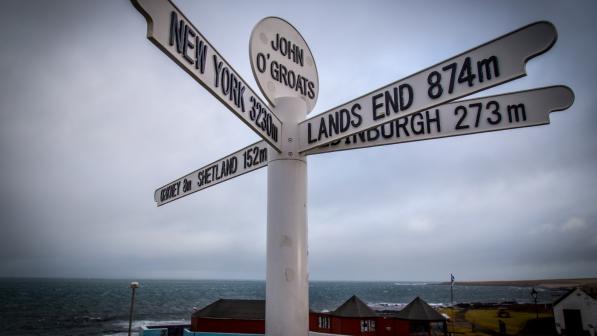
It began at dawn on Friday, June 15, 2018, under the iconic signpost at Land's End. Broadwith clipped in at 8:00 a.m., the Atlantic crashing nearby, and vanished into the Cornish lanes. His goal: beat Gethin Butler's 17-year-old record of 44 hours, 4 minutes, and 20 seconds (set in 2001), a time many deemed untouchable due to its blend of raw power and cunning pacing. Broadwith's support crew—family, friends, and a rotating cast of drivers in unmarked vans—followed discreetly, adhering to strict Road Records Association (RRA) rules: no drafting, no outside assistance beyond food and mechanical fixes at pre-approved stops.
The first hours were a frenzy. Broadwith hammered through Devon and Somerset at 22–25 mph on flats, his legs a piston blur. By evening, he'd crossed into Wales, the Black Mountains testing his climbing gears. Night fell around Bristol, and the real grind began, unlit roads, fatigue clawing at his eyelids, and hallucinations flickering in the headlights. He pushed through Gloucester and the Cotswolds, averaging 19.4 mph overall—a blistering pace that turned the 841-mile slog into a sprint.
Saturday blurred into dawn. The Pennines' brutal climbs in northern England slowed him to 10–12 mph, but Broadwith's strategy shone: short, fierce bursts on ascents, then recovery spins on descents. Wind howled off the North Sea as he hit Yorkshire, but he stayed fuelled—handovers of rice balls and caffeine shots kept the engine roaring. By now, sleep deprivation hit hard; he'd snatched just 20-minute dozes in the van at fuel stops, his crew timing them with military precision. "It was like riding through fog—your brain screams to stop, but you just... keep turning the pedals," he later recalled.
Scotland brought the finale: the Grampian hills, then the exposed A9 highway to the top. Crossing into the Highlands, he was a ghost—salt-crusted kit, eyes bloodshot, but unbreakable. At 3:25 a.m. on Sunday, June 17, after 43 hours, 25 minutes, and 13 seconds of pure propulsion, he rolled under the John o' Groats signpost. Cheers erupted from his exhausted crew. He'd shaved 38 minutes and 47 seconds off Butler's mark, averaging 19.4 mph across diverse terrain. GPS trackers and witnesses verified every pedal stroke for the Guinness World Records and RRA.
The Aftermath: Legacy of a Lightning Bolt
Broadwith collapsed into a van for 18 hours of sleep, waking to headlines calling it the first LEJOG breakthrough in 17 years. The ride wasn't flawless—chafing, saddle sores, and a near-crash from a drowsy swerve—but it redefined possibility. "It's not about talent; it's about preparation meeting opportunity," he said. His record still stands as of late 2025, the men's solo benchmark on a conventional bicycle (though niche categories like recumbents or folding bikes have faster times in their silos).
For women, the parallel story is Christina Mackenzie's 2021 heroics: 51 hours, 5 minutes, and 27 seconds, smashing the prior female mark by over 90 minutes in a sleep-starved odyssey through rain-lashed highlands. But Broadwith's tale remains the gold standard—a reminder that the fastest journeys aren't just physical, but battles of the mind across Britain's wild spine.
If you're inspired to tackle LEJOG yourself (at any pace), resources like the Cycle End-to-End website offer route tips. Just remember: the true record is finishing, not the clock. What's your next ride?
Visit our website: www.custombikefit.com
Submit a bike fit enquiry: CLICK HERE
Call Michael: 0400 510 515
